




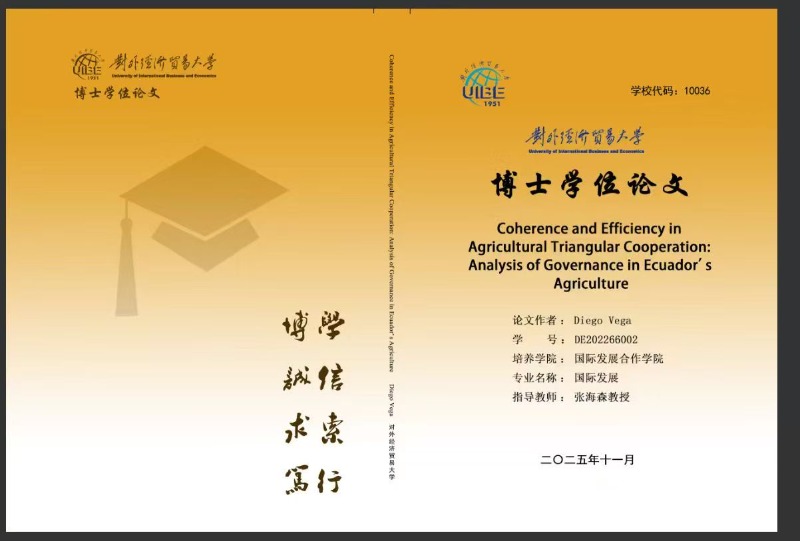
Coherence and Efficiency in Agricultural Triangular Cooperation: Analysis of Governance in Ecuador’s Agriculture
Editorial:Vega Cevallos, Diego Fernando
Materia:Desarrollo y crecimiento económicos
Público objetivo:Profesional / académico
Publicado:2026-01-22
Número de edición:1
Tamaño:2979Kb
Soporte:Digital
Formato:Pdf (.pdf)
Idioma:Inglés
Libros relacionados
Innovación y emprendimiento como factores del crecimiento económico en Ecuador El papel de las exportaciones y el desarrollo empresarial - Jaramillo Escobar, Bladimir Heriberto; Rincón Castillo, Elita Luisa Rincón Castillo
Equidad de género en los negocios, las finanzas y la transformación digital en Ecuador: - Cárdenas Pérez, Alisva de Los Ángeles; Fernández Villacrés, Gustavo Eduardo
El Código Sofía - Vinueza Flores, Jimmy Francisco
Del agro al desarrollismo - Castro Cevallos, Biron Hernán
Reseña
Sustainable development and growth are the main goals of the Ecuadorian government. Improving all sectors of the country's economy is a key strategy for achieving balanced growth that aligns with national development policies. In this context, triangular cooperation plays a vital role in achieving these objectives by providing access to technical, financial, and scientific resources that enhance Ecuador's productive capacity and support sound institutional management, which are essential components of its development goals. Effective governance of international development cooperation requires strong, functional, and practical frameworks to ensure consistency and efficiency in implementing agricultural triangular cooperation initiatives in Ecuador.
This research investigates the following question: How do governance structures in Ecuador influence the coherence and efficiency of agricultural triangular cooperation initiatives? Due to the investigation's extensive scope, we identified three sub-questions, each aligned with specific objectives to facilitate a comprehensive analysis. Firstly, the study will analyze the motivations behind the Ecuadorian government's policy decisions within the context of triangular cooperation (RQ1). Secondly, it examines the interactions and dynamics among governance actors to comprehend their impact on governance coherence and project implementation (RQ2). Finally, the research assesses how these governance structures either facilitate or hinder the successful execution of governance in these initiatives (RQ3).
The hypotheses provide a clear and transparent framework for evaluating results that align with the research problem, its sub-questions, and objectives. Each sub-question directly links to a specific hypothesis, which we will analyze using a mixed-methods research approach to improve data collection and test these hypotheses. Applying the OECD evaluation criteria for efficiency and coherence greatly enhances this methodological approach. Combined with the analysis of agricultural triangular cooperation from the perspective of a host country like Ecuador, this offers an innovative contribution to the research. This pioneering approach enhances understanding of systemic coherence and efficiency in development cooperation.
To support this hypothesis, the research will compare two distinct instances of agricultural triangular cooperation implemented in Ecuador. The "Rice + Duck" model will serve as a basis to extract lessons learned, particularly highlighting how planning and implementation deficiencies impeded the achievement of the project's intended objectives. Conversely, the "Bamboo" program exemplifies a successful case, characterized by a coherent governance framework that promotes efficient project execution and generates additional value through triangular cooperation in knowledge exchange, which continues to expand exponentially.
The thesis is organized into seven chapters to create a more concise, analytical structure in response to feedback that called for merging the literature review, theoretical framework, and empirical definitions into two new chapters. Chapter One introduces the research context, central question, and hypotheses. Chapter Two provides a comprehensive review of the academic literature, tracing the evolution of international development cooperation (IDC), governance, and the analysis of South-South and Triangular Cooperation, while highlighting the analytical gaps that justify this study. Chapter Three establishes the research's conceptual framework and theoretical-analytical model, discussing Governance Theory, Neoliberal Institutionalism, and the Critical Post-Development and Buen Vivir approaches. Chapter Four describes the qualitative and comparative research methodology, including case study selection and the OECD's evaluation criteria for coherence and efficiency. Chapter Five offers a comparative analysis of the "Rice+Duck" and "Bamboo" case studies. Chapter Six presents the empirical findings based on the three research sub-questions. Finally, Chapter Seven summarizes the main conclusions, tests the hypotheses, discusses policy implications, and suggests future research directions.
In this regard, the findings reveal that, while Ecuador's governance system for international cooperation is formally coherent across its regulatory and planning frameworks, it faces significant implementation challenges that hinder the effective execution and sustainability of triangular cooperation projects. However, it shows that triangular cooperation can paradoxically provide crucial mechanisms to mitigate these internal inefficiencies. It does so primarily by managing funds through international organizations and by leveraging partners such as China for their adaptable technical solutions. These findings suggest a need for structural governance reforms and a more strategic, demand-driven approach to cooperation to optimize resources and achieve sustainable development outcomes.
This study employs interviews, case studies, and statistical analyses to examine the hypotheses presented in this thesis, with a particular focus on understanding how governance structures in Ecuador influence the coherence and effectiveness of agricultural triangular cooperation initiatives. Data collection involves administering surveys to key government officials and ultimate beneficiaries, conducting interviews with subject-matter experts, and analyzing primary and secondary data from government entities and international organizations. Primary sources include the Ecuadorian Ministries of Agriculture and Foreign Affairs, various international organizations engaged in triangular cooperation, and relevant public policy documents and statistical information from pertinent government and academic institutions. Due to factors beyond the researcher's control, data collection will primarily occur via digital channels.
KEY WORDS: Triangular Cooperation; Agricultural Cooperation; International Development Cooperation; Sustainable Development
